Salesforce Sales Cloud, now rebranded as 'Agentforce Sales' for 2026, is a colossal sales CRM built for complex, enterprise-level sales operations, boasting an aggressive push into autonomous AI agents. This platform isn't for the faint of heart or those seeking a budget solution; it's for organizations ready to invest significant resources into deeply customized sales processes, often at the expense of simplicity and an easy learning curve.
What Is Agentforce Sales?
Agentforce Sales stands as the industry's most dominant customer relationship management (CRM) platform, specifically designed to manage and optimize every stage of the sales pipeline. It serves as a centralized hub for lead, contact, account, and opportunity management, helping sales teams track interactions, nurture prospects, and close deals. For years, the tool has been the go-to for businesses that need highly configurable workflows, extensive reporting, and a vast ecosystem of integrations. Its current evolution focuses heavily on embedding artificial intelligence into daily sales tasks, aiming to transform how sales reps operate.
The platform is best suited for mid-market to large enterprises with established, often complex, sales methodologies. It provides the infrastructure to support intricate sales processes, multi-layered approvals, and detailed forecasting. If your business thrives on meticulous data tracking and requires deep insights into every customer touchpoint, the software offers an unparalleled depth of functionality.
Key Features
The power of Agentforce Sales lies in its extensive feature set, continually expanding with AI capabilities.
Autonomous AI Agents & Intelligence
The 2026 releases heavily emphasize Agentforce AI. This includes autonomous AI agents for tasks like lead generation, nurturing, and even sales management, aiming to reduce manual effort. Agentforce Qualification has expanded to include Contacts and Person Accounts, giving AI more reach in identifying promising prospects. The platform now offers more granular control over AI agent updates, which is crucial for compliance-heavy industries. Einstein Conversation Insights (ECI) has also been upgraded with generative insights, automatically summarizing calls and identifying key trends, saving reps hours of note-taking.
Core Sales Pipeline Management
At its heart, the software provides solid tools for managing the entire sales cycle. You get lead, contact, account, and opportunity management. It helps visualize your pipeline, track deal stages, and manage customer relationships from initial contact to post-sale service. Pipeline Inspection now includes heatmap views, making it easier to spot bottlenecks or prioritize high-value opportunities at a glance.
Customization and Automation
One of the most praised aspects of the platform is its extreme customizability. You can tailor almost every aspect of the CRM, from record layouts and fields to complex workflows and approval processes using the built-in automation tools. The AppExchange offers thousands of third-party apps, extending functionality even further. This flexibility is a double-edged sword, however; it often leads to over-customization and technical debt for many companies.
Forecasting and Quoting
The platform includes sophisticated quoting tools and forecasting capabilities, helping sales leaders predict revenue and manage team performance. Recent updates include improved Territory Management and Alignment-Based Quota Plans, giving businesses more dynamic control over how sales territories are assigned and goals are set.
Reporting and Analytics
The reporting engine is powerful, letting you create highly detailed reports and dashboards to monitor sales performance, track KPIs, and identify trends. Custom Lightning Web Components can now be embedded directly into Dashboards, allowing for even richer, bespoke analytics visualizations. Deep integration with Salesforce Data 360 aims to unify customer data for a more complete analytical picture.
Integration and Ecosystem
Agentforce Sales integrates deeply with the broader Salesforce ecosystem, including Marketing Cloud, Service Cloud, and Commerce Cloud, creating a unified customer view. Its integration capabilities are vast, supported by tools like MuleSoft for complex enterprise integrations. It also offers native Slack integration across most tiers, fostering team collaboration. Retirements like Salesforce for Outlook (Dec 2027) and Lightning Sync (August 2026) show the platform’s continued shift to cloud-native solutions.
Pricing
Salesforce Sales Cloud, or Agentforce Sales, offers a tiered pricing structure that generally requires annual billing, though lower tiers may allow monthly payment at a premium. As of May 2026, per the official pricing page:
- Free Suite: Available for up to 2 users, this tier provides essential features like lead, contact, account, and opportunity management, basic email marketing, case management, and Slack integration. It's a useful starting point for micro-businesses.
- Starter Suite: At $25 per user per month (billed annually or monthly, as of May 2026), this edition offers essential CRM capabilities, building on the Free Suite.
- Pro Suite: Priced at $100 per user per month (billed annually, as of May 2026), it adds more advanced features such as extensive customization, sales automation, quoting, forecasting, and full access to the AppExchange.
- Enterprise Edition: This tier costs $165 per user per month (billed annually, as of May 2026). It includes advanced pipeline management, deal insights, conversation intelligence, workflow and approvals automation, and sandbox access. Note that the Enterprise and Unlimited editions saw a 6% price increase in August 2025.
- Unlimited Tier: At $330 per user per month (billed annually, as of May 2026), you get predictive AI features, sales engagement tools, a Premier Success Plan, a full sandbox environment, and unlimited customizations.
- Agentforce 1 Sales (formerly Einstein 1 Sales): The top-tier offering is $550 per user per month (billed annually, as of May 2026). This includes unmetered Agentforce AI, Salesforce Spiff, Sales Planning, Sales Programs, Salesforce Maps, Tableau Next, Slack Enterprise+, and 1 million Flex Credits.
A 30-day free trial is available for various editions, letting you test the waters before committing.
However, the listed prices are often just the starting line. Hidden costs are a frequent complaint among users and can significantly inflate your total expenditure. These include:
- Implementation Costs: For any non-trivial setup, expect to pay anywhere from $10,000 to over $500,000 (as of May 2026) for professional services, depending on complexity and customization.
- Add-on Modules: Many advanced features are extra. For example, Einstein for Sales can add $75 per user per month (as of May 2026), Sales Programs $100 per user per month (as of May 2026), and Revenue Intelligence $220 per user per month (as of May 2026).
- Success Plans: While the Unlimited tier includes a Premier Success Plan, lower tiers might incur additional costs for faster support or dedicated assistance.
- Integration Costs: Connecting to other systems often requires additional licenses or services, such as MuleSoft, which can be very expensive.
- Admin Salaries: Maintaining and customizing the platform often requires dedicated, highly paid Salesforce administrators or developers.
- Monthly Billing Premium: Opting for monthly billing on lower tiers can add a 20-30% premium to your per-user cost.
- Credits for AI and Data: Features like Data Cloud services cost $1,000 per 100,000 credits (as of May 2026), Marketing AI credits are $2 per 1,000 credits (as of May 2026), and Intelligence and Activation cards run $1,000 per 100,000 segment-activation credits (as of May 2026).
This gets expensive fast, and it's why many small and medium businesses find the total cost of ownership prohibitive.
Pros and Cons
Choosing a platform like Agentforce Sales means weighing its undeniable strengths against its significant challenges.
Pros:
- Unmatched Customizability and Flexibility: You can tailor the platform to fit almost any sales process, reporting need, or workflow. According to a Capterra user: "It's a very capable platform with a lot of flexibility, especially for teams that need detailed reporting, custom workflows, and strong pipeline visibility."
- Comprehensive Functionality: From lead management to advanced forecasting, the software covers nearly every aspect of the sales cycle. Its ability to centralize data from various sources is a huge advantage for creating a 360-degree customer view.
- Scalability for Growth: The platform can easily scale from a small team to a global enterprise with thousands of users, accommodating increasing data volumes and complex requirements.
- Powerful AI-Driven Sales: With the Agentforce rebrand, the platform is at the forefront of AI innovation in sales, offering autonomous agents and generative insights that can significantly boost productivity for the right teams.
- Vast Ecosystem and Integrations: The AppExchange and extensive API capabilities mean the software can integrate with virtually any other business system, providing a connected environment.
- Market Dominance and Resources: It's the market leader for a reason. There's a massive community, plenty of documentation, and a huge pool of certified professionals.
Cons:
- High Cost and Hidden Fees: The upfront per-user costs are significant, but the real surprise often comes from the numerous add-ons, implementation services, and credit-based AI features. As one G2 reviewer put it: "Salesforce in general, almost everything is an additional cost. Whether it be another cloud service, a feature license, and sometimes even the integrations."
- Steep Learning Curve and Complexity: New users often struggle with the platform's depth and interface. As Elena Perez noted on Capterra: "Salesforce has a steep learning curve. I've been using it for a couple of years, and I know that I still have barely scratched the surface of what I could be able to do." This complexity can hinder user adoption, especially among sales reps who prefer simple, quick tools.
- Data Quality and Governance Challenges: Despite the push for advanced AI, many organizations struggle with foundational CRM issues like maintaining clean data and consistent governance. Over-customization can exacerbate this, leading to technical debt and making upgrades difficult.
- Inconsistent Customer Support: While premium support options exist, general customer support quality can be mixed, and sometimes it's hard to get specific issues resolved, with some users reporting a focus on new product marketing over existing feature fixes.
- Data Storage Limits: A Capterra user complained: "Data storage limits out of the box are restrictive, and the cost for additional storage is very high." Running out of storage can quickly add to costs.
- Focus on AI Over Basic Fixes: Some users feel the company is "hell bent on AI adoption, at the expense of very simple, effective fixes," as one G2 reviewer observed. This creates a "headless" feeling where new, flashy features are prioritized over addressing long-standing user requests for core functionality improvements.
Who Should Use Agentforce Sales?
Agentforce Sales is specifically designed for a particular type of business and sales organization, not every one.
- Large Enterprises and Mid-Market Companies with Complex Sales: If your sales process involves multiple stages, intricate approval flows, extensive product catalogs, and requires detailed forecasting across diverse territories, the platform is built for you. Think companies with 50+ sales reps and a dedicated sales operations team.
- Organizations Requiring Deep Customization: Businesses that need to tailor their CRM to perfectly match unique industry requirements or proprietary sales methodologies will benefit from its unparalleled flexibility. This means having the resources for dedicated administrators and developers.
- Teams Ready for AI-Powered Sales Transformation: If you're serious about using autonomous AI agents for lead qualification, deal insights, and sales automation, and you have robust, clean data to feed the AI, Agentforce Sales is leading the pack.
- Businesses Prioritizing a Unified Ecosystem: Companies already using or planning to use other Salesforce Clouds (Marketing Cloud, Service Cloud) will find the deep integration of this tool invaluable for a holistic customer view.
- Fast-Growing Businesses with High Scalability Needs: If you anticipate rapid growth in your sales team, data volume, and process complexity, the platform can scale to meet those demands.
It's not for small businesses looking for a simple, out-of-the-box solution with a low total cost of ownership. For those teams, alternatives like HubSpot Sales Hub or Pipedrive often offer better value and a gentler learning curve.
Data at a Glance
| Metric | Value | Source |
|---|---|---|
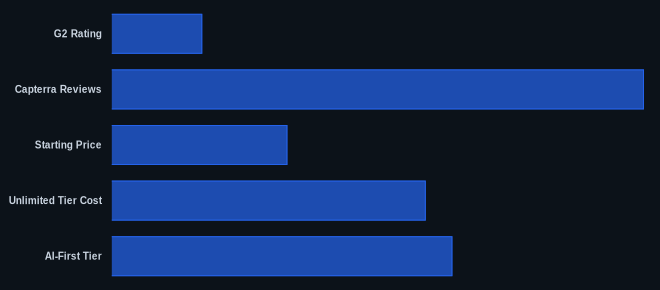
| G2 Rating | 4.4 out of 5 stars | G2 Reviews |
| Capterra Reviews | 18,781 verified user reviews | Capterra Reviews |
| Starting Price | $25 per user per month | Salesforce Pricing (Starter Suite, billed annually, as of May 2026) |
| Free Tier | Yes, for up to 2 users | Salesforce Pricing |
| Unlimited Tier Cost | $330 per user per month | Salesforce Pricing (Billed annually, as of May 2026) |
| Enterprise Price Hike | 6% in August 2025 | Salesforce Blog |
| AI-First Tier | $550 per user per month | Salesforce Pricing (Agentforce 1 Sales, billed annually, as of May 2026) |
Our Take
The rebranding to Agentforce Sales highlights a clear strategic direction: Salesforce is betting big on AI. The autonomous agents and generative insights are genuinely powerful and will redefine how many sales teams operate, if those teams are prepared. But for many customers, the aggressive push into AI feels disconnected from their core struggles. It's like building a rocket on a shaky foundation. Yes, the platform can do anything, but its immense customizability often leads to technical debt, poor data quality, and user resistance. Investing in Agentforce Sales makes sense for organizations with robust data governance, dedicated admin resources, and a clear strategy to integrate AI, not just implement it. If your basic CRM data is a mess, throwing advanced AI at it won't magically fix your sales problems; it'll just give you sophisticated insights into bad data.
If you are a large enterprise with a complex sales process, considering Agentforce Sales, how are you ensuring your foundational CRM data quality keeps pace with the platform's rapid AI advancements?
FAQ
Is Agentforce Sales worth the investment for my growing SMB?
It depends heavily on your definition of "growing SMB." If you're a small team with less than 20 reps, prioritizing simplicity and lower initial cost, probably not. HubSpot Sales Hub or Pipedrive might be a better fit. But if your SMB has a complex sales process, anticipates rapid scaling with dedicated admin resources, and views CRM as a strategic advantage rather than just a contact database, its Enterprise or Unlimited tiers could be a long-term play. Be prepared for significant hidden costs.
How long does it take to implement Agentforce Sales?
Implementation time varies wildly based on your edition, customization needs, and existing data. A basic Starter Suite setup might take a few weeks. However, for Pro, Enterprise, or Unlimited editions with integrations and custom workflows, you're looking at 3 to 12 months, or even longer. Factor in significant time for data migration, user training, and ongoing optimization, often requiring a dedicated project team or external consultants.
What are the main alternatives to Agentforce Sales?
For teams seeking more simplicity and native marketing integration, HubSpot Sales Hub is a strong contender, offering a useful free tier and a more intuitive UI. If your business is already entrenched in the Microsoft ecosystem, Microsoft Dynamics 365 Sales provides tight integration with other Microsoft products and offers on-premises deployment options. For sales teams focused purely on pipeline visualization and quick setup, Pipedrive offers a leaner, more visual approach at a lower starting price.
