Zoho CRM is an ambitious platform that offers a free plan and a comprehensive feature set, but its alarming pattern of major system outages in early 2026 makes us hesitant to recommend it for mission-critical operations without a robust contingency plan. This review is for entrepreneurs, remote teams, and SMBs evaluating the platform for sales, marketing, and customer service needs.
What Is Zoho CRM?
This customer relationship management solution centralizes sales, marketing, and customer support activities for businesses of all sizes. It helps companies manage leads, track deals, automate workflows, and maintain customer relationships through a unified interface. The tool targets businesses looking for a highly customizable and feature-rich CRM that can grow with their needs, particularly those already invested in the broader Zoho ecosystem.
Key Features
The platform's strength lies in its extensive features, offering capabilities often reserved for much pricier competitors.
Sales Automation & Pipeline Management
It provides detailed lead, deal, and account management, letting sales teams track every interaction. You can build multiple sales pipelines, set up custom dashboards, and use forecasting tools to predict revenue. The Professional Plan introduces sales process automation with Blueprint, guiding reps through predefined sales stages. This helps standardize processes, which is a big win for consistency.
AI Capabilities (Zia)
Zoho's AI assistant, Zia, is a significant differentiator, especially in the Enterprise Plan and above. Zia offers predictive AI for lead and deal scoring, helping reps prioritize their efforts. It can forecast win probabilities, detect anomalies in data, and analyze email sentiment. Updates in Q1 2026 brought Natural Language Formula Generation and Improved Smart Prompts, letting users generate complex CRM formulas or use LLMs with simple commands (as of March 2026, per Q1 2026 updates). Zia also supports Direct Actions from Zia Insights via custom buttons, speeding up workflows.
Automation & Customization
One of the most praised aspects of the platform is its deep customization. You can create custom modules, fields, and complex workflows without extensive coding. The Professional Plan adds webhooks, expanding automation possibilities beyond the native features. For businesses with unique processes, Custom Functions in the Enterprise Plan allow for highly tailored solutions using Deluge scripting. This is excellent if you have a developer on staff or a dedicated consultant.
Marketing & Customer Service Tools
It bundles email marketing capabilities, starting with 250 mass emails per day in the Standard Plan (as of May 2026, per the official pricing page), increasing to 2,000 in the Ultimate Plan (as of May 2026, per the official pricing page). The Voice of the Customer (VoC) updates (as of March 2026, per Q1 2026 updates) aggregate sentiment and trends, helping businesses understand customer feedback better. For customer support, it helps manage inquiries and track service history, ensuring a holistic view of the customer journey.
Integrations and Ecosystem
Its most solid integrations are found within the vast Zoho ecosystem, which includes over 55 other applications like Zoho Books, Zoho Marketing Automation, and Zoho Desk. This lets you have a truly unified business operation if you commit to the Zoho suite. Updates in May 2025, like Connected Records and Connected Workflows, further enhance inter-departmental collaboration across these apps, speeding up complex business processes.
Pricing
Zoho CRM uses a tiered, per-user-per-month pricing model, with notable discounts for annual billing. As of May 2026, per the official pricing page:
- Free Edition: $0 per month for up to 3 users. This includes basic CRM, email marketing, and multichannel communication. It's a great starting point for very small teams.
- Standard Plan: $14 per user per month (billed annually) or $20 per user per month (billed monthly). This plan adds mass emailing (250/day), multiple pipelines, custom dashboards, forecasting, and workflows. For many SMBs, this is where the real value begins.
- Professional Plan: $23 per user per month (billed annually) or $35 per user per month (billed monthly). Here, you get sales process automation (Blueprint), quote and inventory management, Google Ads integration, and more advanced automation with webhooks. Email limits increase to 500 per day.
- Enterprise Plan: $40 per user per month (billed annually) or $50 per user per month (billed monthly). This tier adds Zia's advanced AI capabilities, territory management, custom functions, multi-user portals, and sandbox testing. This plan increased from $35/month to $40/month in 2021, a 14.3% jump over seven years.
- Ultimate Plan: $52 per user per month (billed annually) or $65 per user per month (billed monthly). This is the top-tier, offering everything in Enterprise plus Zoho Analytics, 2,000 daily emails, expanded storage, and priority support.
Potential hidden costs are a concern. Extra data storage can add up, costing $2.85 per 100MB per month for teams with 1-200 users (as of May 2026, per Zoho's pricing details). Complex implementation and customization, especially for larger setups, can range from $2,000 to $25,000+ (as of May 2026, based on industry estimates for complex setups). Remember to budget for third-party integrations, specialized training, and support beyond the standard offerings. This gets expensive fast if you don't plan carefully.
Pros and Cons
Pros
- Exceptional Value for Features: It offers enterprise-grade features, particularly automation and AI, at a much lower cost than competitors like Salesforce or HubSpot. This makes it ideal for budget-conscious SMBs.
- Extensive Customization: Users can tailor almost every aspect, from custom modules and fields to intricate workflows and Deluge scripting. According to a G2 reviewer: "What I like best about Zoho CRM is how easy it is to manage leads and customer data in one place. The interface is quite user-friendly, so daily tasks like follow-ups, updating deals, and tracking conversations become simple."
- Solid Automation: The platform provides powerful automation capabilities, often available in lower tiers than you'd find elsewhere. This helps speed up repetitive tasks.
- Seamless Zoho Ecosystem Integration: If you use other Zoho products, the integration is fluid and comprehensive. This creates a unified environment for various business functions.
- Clear Pricing: Compared to some competitors, the pricing structure is generally transparent, minimizing unexpected costs—though hidden service costs exist.
Cons
- Significant Downtime Issues in 2026: This is our biggest red flag. The tool has experienced multiple major outages in early 2026, including one lasting over 18 hours on May 3, 2026. This starkly contradicts their 99.9% uptime SLA and can severely disrupt operations. Source: StatusGator.
- Steep Learning Curve and Complexity: Many users find the sheer number of features overwhelming, leading to a challenging onboarding process, especially for new team members. "The biggest letdown is the inconsistent and slow customer support, which struggles to resolve issues with the platform's steep learning curve and overly complex interface," a G2 reviewer notes.
- Inconsistent Customer Support: Despite some positive mentions, a common complaint is the unreliability and slowness of support. Resolving complex issues can be a drawn-out process of "email tag," and sometimes premium support tiers are necessary for effective help.
- Dated UI and Performance Issues: Some users describe the interface as cluttered and visually outdated. There are also reports of occasional performance lag, particularly when dealing with large datasets.
- Implementation Challenges Post-Year Two: Many businesses struggle with the platform after the initial setup, citing poor planning, neglected optimization, and fragmented integration logic. It requires ongoing internal management to truly succeed long-term.
Who Should Use Zoho CRM?
This platform is best suited for small to medium-sized businesses (SMBs) and entrepreneurs who are price-sensitive but refuse to compromise on features. If you have a relatively complex sales process, require deep customization, and are either comfortable with a learning curve or have internal technical expertise, it's a strong contender.
It's also an excellent choice for businesses already using other Zoho ecosystem applications, as the native integration significantly enhances its value. Teams that need solid automation capabilities but find Salesforce Sales Cloud too expensive or HubSpot CRM too restrictive in its free/lower tiers will find a lot to like here.
However, if your business cannot tolerate any downtime, or if your team prioritizes ease of use and a pristine UI above all else, you might find the recent reliability issues and general complexity frustrating. Companies with very basic CRM needs might be better served by a simpler tool like Pipedrive, while those needing extensive third-party integrations might find HubSpot or Salesforce's ecosystems more developed.
Data at a Glance
| Metric | Value | Source |
|---|---|---|
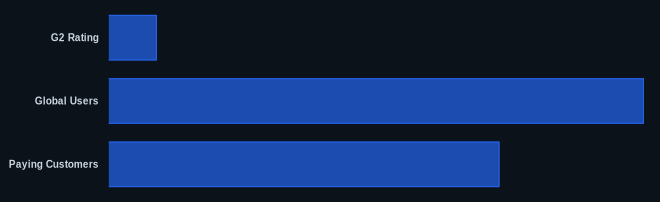
| G2 Rating | 4.1/5 (2,800+ reviews) | G2.com |
| Capterra Rating | Generally positive (contradictory support mentions) | Capterra.com |
| Starting Price | $0 (Free Edition for up to 3 users) | Zoho.com/crm/pricing.html |
| Global Users | 150 Million (as of Feb 2026) | Zoho.com |
| Paying Customers | 1 Million+ (as of Feb 2026) | Zoho.com |
| Free Tier | Yes | Zoho.com/crm/pricing.html |
| Longest Outage 2026 | 18 hours, 31 minutes (May 3, 2026) | StatusGator.com |
Our Take
Zoho CRM is a phenomenal value for its feature set, especially if you're deep into the Zoho ecosystem, letting businesses achieve incredible efficiency by leveraging its deep customization and powerful automation to tailor operations precisely. But the multiple, lengthy outages in early 2026—including one lasting over 18 hours—are not just a blip; they are a systemic warning sign that undermines the entire value proposition of a "mission-critical" CRM. You can have all the AI-powered features in the world, but if your sales team can't access customer data for nearly a full day, the business grinds to a halt. While the platform offers many benefits, you must have a backup plan for data access and operations during potential future outages. Don't assume their SLA guarantees cover your real-world risk.
If you're considering Zoho CRM for your business, how crucial is uninterrupted uptime versus extensive customization and lower cost for your daily operations?
FAQ
Q: Is Zoho CRM truly "AI-powered" as of 2026?
A: Yes, it boasts significant AI capabilities through Zia, especially in its Enterprise and Ultimate plans. Zia offers predictive scoring, natural language formula generation, email drafting, and real-time analytics. Many of these features were enhanced or introduced in Q1 2026 updates (as of March 2026, per Zoho's product updates), making it a genuinely AI-enhanced CRM.
Q: How does Zoho CRM's pricing compare to alternatives like HubSpot or Salesforce?
A: It is generally much more affordable than Salesforce Sales Cloud or HubSpot's equivalent paid tiers for a similar range of features, especially for SMBs. You get many advanced features, including AI and extensive customization, at a significantly lower per-user cost (as of May 2026, per the official pricing page). However, be mindful of potential hidden costs for implementation, advanced support, and additional storage.
Q: Given the reported outages, is Zoho CRM a reliable choice for my business?
A: The numerous and lengthy outages reported in early 2026 are a serious concern that directly contradicts their stated 99.9% uptime SLA. While the platform offers a solid feature set and strong value, businesses that require constant, uninterrupted access to their CRM might consider the recent reliability issues a significant risk. We recommend evaluating your risk tolerance and having contingency plans in place if you choose this platform.