For entrepreneurs and SMBs making critical software choices, the 2026 CRM market offers a clear divergence: HubSpot reigns as the unified growth platform for customer-centric scaling, while Pipedrive continues its focus on hyper-efficient, visual sales pipeline management. HubSpot's September 2024 free CRM limitations and Pipedrive’s November 2025 plan rebrand created distinct value propositions, making the choice about more than just features.
What Is HubSpot?
HubSpot serves as a customer platform designed to support inbound strategies across marketing, sales, service, and content. It’s built for businesses seeking to align their go-to-market teams around a shared customer view, automating processes from lead generation to post-sale support. The platform provides a suite of tools under a single umbrella, letting companies nurture relationships and drive growth. It caters particularly well to organizations committed to long-term customer engagement and data-driven decision-making.
What Is Pipedrive?
Pipedrive is a sales-first CRM, purpose-built for visual pipeline management and optimizing sales processes. This tool helps sales teams track deals, manage leads, and automate administrative tasks to close more deals efficiently. It emphasizes an intuitive, activity-based approach, ensuring sales reps know exactly what actions to take next. The software is ideal for sales-driven SMBs and teams that prioritize a clear, easy-to-use interface for managing their sales funnel.
Key Features
HubSpot: Unified Customer Growth
HubSpot organizes its extensive features into "Hubs," all built on a central CRM database.
- Marketing Hub: Here is where its inbound power shines. It includes AI-driven content creation with Breeze AI, advanced SEO tools, blogging, email marketing, and marketing automation. For example, the AI image generator and content remix features help teams quickly create engaging campaigns.
- Sales Hub: From email sequences and meeting scheduling to playbooks and AI deal coaching, the Sales Hub equips sales teams with tools to speed up their outreach and improve conversion rates. Features like Smart Deal Progression use AI to guide reps through the sales cycle.
- Service Hub: Designed to enhance customer satisfaction, this hub offers an automated help desk, customer portals, SLAs (Service Level Agreements), and conversation bots for consistent support. It integrates deeply with sales and marketing for a unified customer view.
- Content Hub: Providing premium hosting, blog management, and AI assistants, this hub supports content creation and distribution, making it easier for businesses to publish and manage their digital assets efficiently.
- Data Hub: This critical component enables programmable automation, data sync, and data quality management. It offers solid connections to external data warehouses like Snowflake and BigQuery, ensuring data integrity and accessibility for advanced analytics.
Pipedrive: Sales Efficiency & Pipeline Visibility
Pipedrive focuses keenly on sales execution and visibility within the pipeline.
- Visual Sales Pipeline: At the core of the platform, unlimited deal pipelines let teams visualize their sales process with a drag-and-drop interface. This helps sales reps quickly understand deal progress and identify bottlenecks.
- Lead & Deal Management: The software provides tools for managing leads, deals, and activities. Features like Deal Rotting alert users to stagnant deals, prompting timely follow-ups.
- Pulse AI: Launched in July 2025, this AI offers lead scoring, call summaries, and drafts for follow-up emails, significantly boosting sales productivity.
- Email Sync & Automation: Full email synchronization and open/click tracking come with the Growth Plan. Basic workflow automation, with approximately 30 active automations per user, helps standardize sales tasks.
- Add-ons for Enhanced Sales:
- LeadBooster: An add-on featuring a prospector, live chat, chatbots, and web forms to capture leads directly from websites.
- Smart Docs: Provides eSignatures and document management, included in the Premium and Power plans, or available as an add-on for others.
- Projects: Offers Kanban boards and project planning tools, ideal for managing post-sale activities or complex deals.
Pricing
The pricing structures of these platforms significantly diverged by July 2026, driven by their respective strategic updates.
HubSpot Pricing 2026
HubSpot operates on a modular "Hubs" approach, with pricing scaling based on contacts and required features. The core CRM is free, but with new limitations.
- Free CRM: This plan offers essential contact management, email tracking, and basic reporting. Crucially, as of September 2024, the contact cap was reduced to 1,000 contacts and limited to 2 users (as of July 2026, per the official pricing page). This makes it less viable for even small, growing teams who previously relied on its more generous free tier.
- Starter Plan: Starts at $9 per seat per month when billed annually (as of July 2026, per the official pricing page), or $20 per seat per month month-to-month (as of July 2026, per the official pricing page). This includes 500 HubSpot Credits and removes HubSpot branding. Marketing Hub Starter supports up to 1,000 contacts.
- Professional Plan: Starting at $1,300 per month (as of July 2026, per the official pricing page), this includes 6 core seats, with additional seats at $45 each (as of July 2026, per the official pricing page). Marketing Hub Professional begins at $890/month for 3 seats (as of July 2026, per the official pricing page), while Sales Hub Professional is approximately $100 per month per sales seat (as of July 2026, per the official pricing page). This tier is designed for growing teams needing advanced automation, reporting, and personalization.
- Enterprise Plan: Begins at $4,700 per month (as of July 2026, per the official pricing page), including 8 core seats, with additional seats at $75 each (as of July 2026, per the official pricing page). This plan targets large organizations with complex operations, requiring advanced permissions and enterprise data management.
Contact-based pricing scales significantly. For example, 1,000 marketing contacts might cost around $50/month on the Starter plan (as of July 2026, per the official pricing page), while 100,000 contacts can reach approximately $4,040/month (as of July 2026, per the official pricing page). Overage charges for contacts are typically $0.003-$0.004 per contact per month (as of July 2026, per the official pricing page).
Hidden Costs can include HubSpot credits ($45/month for 5,000 credits) (as of July 2026, per the official pricing page) for enhanced limits (SMS, WhatsApp, API, etc.) and mandatory onboarding fees for Professional and Enterprise tiers, ranging from $1,500 to $7,000 (as of July 2026, per the official pricing page).
Pricing Source: HubSpot Pricing Page, as of July 2026.
Pipedrive Pricing 2026
Pipedrive, following its November 2025 rebranding, moved away from a permanent free version, instead offering a free trial. Its plans are per-user, making costs more predictable for sales teams.
- Lite Plan (formerly Essential): Starts at $14 per user per month when billed annually (as of July 2026, per the official pricing page), or $24 per user per month monthly (as of July 2026, per the official pricing page). This includes core pipeline management, a sales assistant, AI-generated reports, and 500+ integrations.
- Growth Plan (formerly Advanced): Starts at $34 per seat per month annually (as of July 2026, per the official pricing page), or $49 per seat per month monthly (as of July 2026, per the official pricing page). This tier adds full email sync, open/click tracking, and basic workflow automation.
- Premium Plan: Starts at $49 per seat per month annually (as of July 2026, per the official pricing page), or $79 per seat per month monthly (as of July 2026, per the official pricing page). This is a significant value tier, including advanced AI features, more customizations, Smart Docs (with eSignatures), and the LeadBooster add-on (live chat, chatbots, web forms).
- Power Plan: Priced at 99 EUR per user per month (approximately $108 USD) (as of July 2026, per the official pricing page). This plan adds team-level controls, project planning, phone support, and higher automation/AI usage caps.
- Enterprise Plan: Offers custom pricing for unlimited platform experience and advanced needs.
Add-ons are a key consideration for the Lite and Growth plans. LeadBooster costs $32.50/month annually (as of July 2026, per the official pricing page), Smart Docs is $32.50/company monthly annually (as of July 2026, per the official pricing page) (included in Premium/Power), and Projects is $6.70/user/month (as of July 2026, per the official pricing page). Email Campaigns is an additional charge, starting around 13 EUR/company/month for 1,000 active contacts (as of July 2026, per the official pricing page).
Pricing Source: Pipedrive Pricing Page, as of July 2026.
Pros and Cons
HubSpot Pros
- Unified Platform: Integrates marketing, sales, service, and content into one cohesive system.
- Marketing Automation: Offers deep native capabilities for lead nurturing, scoring, and personalized campaigns.
- Advanced AI Features: Breeze AI provides tools for content creation, deal coaching, and prospect research.
- Scalability: Designed to support complex operations and large teams as they grow.
- Comprehensive Reporting: Provides detailed analytics across all customer touchpoints.
HubSpot Cons
- High Cost at Scale: Gets expensive fast, especially with multiple hubs and increasing contact counts.
- Pricing Complexity: The modular, contact-based pricing with add-on credits can be challenging to predict.
- Steep Learning Curve: Advanced features require significant time and training to master.
- Limited Free Tier: The 1,000 contact, 2-user limit on the free CRM is a major drawback for small teams.
- Onboarding Fees: Mandatory onboarding costs for Professional and Enterprise plans add to the initial investment.
Pipedrive Pros
- Intuitive Visual Sales Pipeline: Best for managing deals through a clear, drag-and-drop interface.
- Ease of Use & Quick Setup: Sales teams can get operational very quickly, often within days. According to a G2 reviewer: "If your company is sales focused it is built for that line of work."
- Sales-Centric Design: All features are geared towards maximizing sales efficiency and productivity.
- Predictable Per-User Pricing: Clear pricing tiers make budgeting straightforward for sales teams.
- Value in Premium Tier: The Premium plan bundles significant add-ons like Smart Docs and LeadBooster, offering strong value.
Pipedrive Cons
- Limited Marketing Automation: Lacks native, deep marketing automation features; often requires third-party integrations.
- Reporting Limitations: Lower tiers have basic reporting; advanced analytics often require upgrades or add-ons.
- Add-on Costs: While some features are bundled in higher tiers, key functionalities like LeadBooster or Projects are additional expenses for Lite/Growth users.
- Not an All-in-One Solution: Does not natively integrate service or deep content management as a core offering.
- No Permanent Free Plan: Only offers a free trial, which might deter budget-conscious startups.
Who Should Use Each Tool?
HubSpot is the ideal choice for scaling SMBs and mid-market companies with dedicated marketing, sales, and service teams. If your business strategy revolves around inbound marketing, strong customer relationships, and a unified customer view across all touchpoints, this platform delivers. It suits organizations looking for deep analytics, advanced automation, and a platform that can grow with their entire customer journey, not just sales. Companies with 10+ employees that are already seeing traction and need to optimize their entire go-to-market engine will benefit most.
Pipedrive is the clear winner for sales-focused SMBs, particularly those with 1-30 sales representatives, who prioritize efficient deal management and a clear sales pipeline. If your primary goal is to let your sales team use an intuitive tool to track leads, manage activities, and close deals quickly, this software excels. It’s perfect for businesses that value simplicity, quick adoption, and a visual approach to sales, without needing extensive marketing automation or customer service features natively built-in. Startups or small sales agencies that need to hit the ground running will find it highly effective.
Data at a Glance
| Feature/Metric | HubSpot CRM | Pipedrive | Source |
|---|---|---|---|
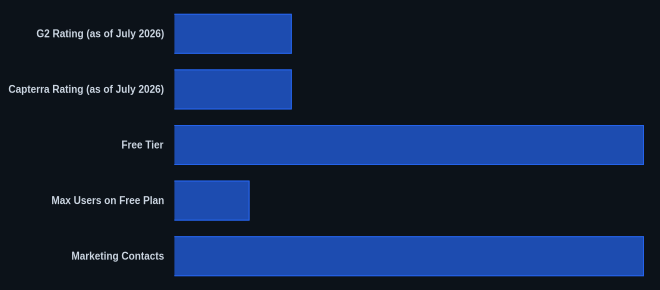
| G2 Rating (as of July 2026) | 4.6/5 stars (CRM specific, 1,371 reviews) | 4.3/5 stars (3,034 reviews) | G2 |
| Capterra Rating (as of July 2026) | 4.5/5 stars (4,414 reviews) | 4.5/5 stars (3,050 reviews) | Capterra HubSpot CRM, Capterra Pipedrive |
| Starting Price | $0/month (Free CRM, limited users/contacts) | $14/user/month (Lite, billed annually, as of July 2026) | HubSpot Pricing, Pipedrive Pricing |
| Free Tier | Yes (1,000 contacts, 2 users, as of Sept 2024) | No (Free Trial Only) | HubSpot Pricing, Pipedrive Pricing |
| Core Focus | Customer Platform (Marketing, Sales, Service) | Sales CRM (Pipeline Management) | HubSpot.com, Pipedrive.com |
| Max Users on Free Plan | 2 users (as of Sept 2024) | N/A (no permanent free plan) | HubSpot Pricing |
| Marketing Contacts | 1,000 in Free/Starter Marketing Hub (as of Sept 2024) | Unlimited (Campaigns add-on for email marketing) | HubSpot Pricing, Pipedrive Pricing, Pipedrive.com |
Our Take
In 2026, the choice between these two platforms isn't just about features or price; it's about your strategic business philosophy. We see HubSpot as the investment in an all-encompassing, future-proof customer platform where Marketing, Sales, and Service aren't just integrated, but genuinely unified. Yes, it's pricey and complex at scale, but if you're building a business around a customer-centric growth model, its native capabilities deliver an experience no collection of integrations can truly match. Pipedrive, however, remains the champion for sales teams needing immediate, tangible results without the overhead of a full growth suite. It does one thing exceptionally well: drive sales through clear, actionable pipeline management. If your business lives and dies by the sales numbers, and you need a tool that your reps will actually use without extensive training, then Pipedrive at its Premium tier is likely your most efficient path to success.
If you're a growing SMB currently using Pipedrive, at what point did you consider its marketing automation limitations a deal-breaker, prompting a look at all-in-one solutions?
FAQ
Which CRM is better for very small teams or startups on a tight budget in 2026?
For very small teams, the decision depends on your exact needs. HubSpot's free CRM, while limited to 1,000 contacts and 2 users (as of September 2024, per the official pricing page), still offers basic functionality for zero cost. However, if you quickly exceed those limits, the Starter plans can get expensive. Pipedrive offers a free trial, but its entry-level Lite Plan at $14 per user per month (annually) (as of July 2026, per the official pricing page) provides a fully functional, albeit sales-focused, CRM without contact limits, which might be more predictable for a growing sales team. Consider how many contacts you expect to manage and how many users need access; that will dictate which platform offers better initial value.
Can Pipedrive effectively handle marketing automation, or do I need other tools?
While Pipedrive offers some basic workflow automation, it is not designed as a comprehensive marketing automation platform. Its strengths lie in sales process automation, email sync, and deal management. For advanced marketing functions like lead nurturing, deep email campaigns beyond simple group sends, landing pages, or sophisticated lead scoring, you will likely need to integrate Pipedrive with a dedicated marketing automation tool like Mailchimp or a more robust solution via Zapier. HubSpot, by contrast, has extensive native marketing automation built directly into the platform.
What are the main hidden costs and difficulties when switching between these two CRMs?
The biggest hidden switching costs are data migration complexity, training, and integration rework. Moving from Pipedrive to HubSpot for basic contact and deal data is generally straightforward, but preserving historical emails, calls, notes, and custom fields requires careful planning and often specialized tools or services due to structural differences. Switching from HubSpot to Pipedrive can be less complex on the data side but still demands meticulous data cleaning and mapping. Both migrations involve significant labor for training teams on the new system, recreating or reconfiguring third-party integrations, and potential downtime. Furthermore, if you're moving to HubSpot, be prepared for potential mandatory onboarding fees at Professional and Enterprise tiers.