In 2026, Mailchimp's Premium Plan starts at $250.00+/month (as of early 2026, per the official pricing page), making it a sophisticated, AI-powered growth engine designed to help small to medium-sized businesses, e-commerce stores, and content creators automate, personalize, and optimize their customer engagement across multiple channels. This review is for entrepreneurs and marketing managers seeking a powerful, user-friendly tool to scale their outreach without needing a full enterprise solution.
What Is Mailchimp?
Mailchimp serves as a centralized hub for audience management, content creation, campaign execution, and performance tracking across email, social media, and increasingly, SMS. It was built with ease of use in mind, letting businesses connect with their customers through targeted messages and automated sequences. The platform’s core strength lies in its marketing tools, evolving from a simple newsletter service into a multifaceted marketing assistant. Its goal is to help businesses turn casual browsers into loyal customers through smarter, more personalized interactions.
Key Features
The platform's evolution has heavily leaned into artificial intelligence and enhanced automation, making it a strong contender for businesses focused on growth.
AI-Powered Content & Personalization
The tool makes content creation far less daunting. Its AI-Powered Content Generation helps draft compelling subject lines, body copy for emails, and social media posts. You simply provide a few prompts, and the AI suggests variations tailored to your audience. This saves significant time for marketing teams, especially those without dedicated copywriters. According to Jessica R., a Marketing Coordinator: "Designing emails is intuitive, and the new AI content suggestions are a game-changer for writer's block."
One surprising finding from early 2026 feedback highlights the Creative Assistant's effectiveness. This lesser-advertised feature uses AI to generate on-brand designs and content variations, dramatically speeding up content creation and A/B testing efforts. Many users initially overlooked it but found it incredibly valuable once discovered.
The platform also offers Predictive Segmentation, using AI-driven insights to automatically group contacts. It assesses purchase likelihood, engagement levels, and churn risk, giving marketers a clearer picture of their audience without manual data analysis. This means you can target high-value customers or re-engage at-risk subscribers more effectively.
For e-commerce businesses, Dynamic Product Recommendations are now standard. This enhanced integration uses AI to suggest relevant products to subscribers based on their browsing history and past purchases. It's a proven way to increase average order value and customer lifetime value.
Advanced Automation & Journeys
Mailchimp's automations have always been a strong suit, and in 2026, the Advanced Journey Builder makes complex multi-channel workflows even more intuitive. It features a drag-and-drop interface, allowing users to visually map out customer pathways. These journeys can include welcome sequences, abandoned cart reminders, and post-purchase follow-ups. Sarah L., a Small Business Owner, noted in a G2 Review: "Mailchimp's automations have saved us countless hours. We set up welcome sequences once, and they just work, keeping our new subscribers engaged without constant manual effort." That kind of hands-off engagement is priceless for busy teams.
Send-time optimization is another intelligent automation feature. It analyzes past engagement data to send emails when recipients are most likely to open them.
Multi-channel Engagement
Beyond email, the software deepens its reach with SMS Marketing Integration. This allows businesses to incorporate SMS campaigns directly into their existing email marketing workflows. It's perfect for urgent updates, promotions, or transactional messages, providing another critical touchpoint with customers. Integrating these channels under one roof simplifies campaign management significantly.
Enhanced Reporting & Analytics
Data is king, and the platform delivers with Enhanced Reporting Dashboards. These customizable dashboards provide granular data and AI-powered insights into campaign performance. You can quickly see what's working, what isn't, and where to optimize. It helps businesses make data-driven decisions swiftly, refining their strategies for better ROI. The predictive insights offered help forecast trends and inform future campaigns.
Pricing
Mailchimp offers a tiered pricing structure designed to grow with your business, with plans scaling based on contact count and features. It's crucial to evaluate your contact list size and feature needs before committing.
As of early 2026, per the official Mailchimp pricing page (https://mailchimp.com/pricing/):
- Free Plan: This entry-level plan is for beginners and very small audiences. It offers basic email creation and sending, foundational analytics, and a limited audience size. You'll get essential tools to start building your list and sending campaigns.
- Price: $0.00/month (as of early 2026, per the official pricing page)
- Includes: Up to 500 contacts, basic email templates, marketing CRM, website builder. Excludes advanced segmentation and AI-powered features.
- Essentials Plan: Aimed at small businesses ready to grow, this tier unlocks more capabilities. It lets you customize your branding and perform A/B tests to optimize content.
- Price: $15.00 – $20.00/month (as of early 2026, depending on contact count, e.g., up to 5,000 contacts)
- Includes: All Free features, custom branding, A/B testing, 24/7 email & chat support, all email templates, basic segmentation.
- Standard Plan: For growing businesses needing more power and automation, the Standard plan steps up the game. This plan introduces significant AI capabilities.
- Price: $30.00 – $60.00/month (as of early 2026, depending on contact count, e.g., 10,000 to 50,000 contacts)
- Includes: All Essentials features, advanced automation, send-time optimization, behavioral targeting, extensive AI-powered content generation tools, dynamic content.
- Premium Plan: This top-tier plan is for larger enterprises requiring comprehensive features, deep insights, and dedicated support. It provides the most advanced AI tools for scaling personalization.
- Price: $250.00+/month (as of early 2026, starting, scales significantly with unlimited contacts)
- Includes: All Standard features, advanced segmentation, multivariate testing, unlimited contacts, phone support, comprehensive analytics dashboards, deeply integrated AI tools for predictive analysis and personalized content at scale, role-based access.
Mark T., an E-commerce Manager, noted on Capterra: "The free tier was perfect for starting out, but as we grew, the limitations became apparent. Upgrading was necessary for features like advanced segmentation, but the price jump felt a bit steep for the additional value received at first." This highlights a common concern as businesses transition from the free or Essentials tiers to more advanced plans. The pricing can feel like a big jump once you hit certain contact thresholds or need sophisticated features.
Pros and Cons
Mailchimp has its strengths and weaknesses, like any mature product. Understanding these trade-offs is key to determining if it's the right fit for your business.
Pros:
- User-Friendly Interface: The platform remains one of the easiest email marketing tools to learn and use, even for marketing novices. Designing campaigns is intuitive.
- Solid Free Tier: It offers substantial functionality for startups or very small businesses to get started without any upfront cost. You can build a list and send basic emails.
- Powerful AI-Driven Features: The integration of AI for content generation, predictive segmentation, and product recommendations significantly boosts marketing efficiency and personalization. This saves a lot of manual effort.
- Strong Automation Capabilities: The advanced journey builder allows for sophisticated multi-step campaigns that engage subscribers effectively, saving countless hours for teams.
- Comprehensive E-commerce Integrations: The tool connects well with popular e-commerce platforms, offering features like abandoned cart automations and dynamic product suggestions.
- Growing Multi-channel Options: With deeper SMS integration, businesses can reach customers on their preferred channels, creating a more unified communication strategy.
Cons:
- Pricing Can Scale Steeply: While the free tier is generous, the cost for advanced features and higher contact counts can become expensive quickly, especially as you move beyond the Standard plan.
- Customer Service Varies: While G2 and Capterra reviews generally praise ease of use, some users have reported slower response times for complex technical issues, particularly on lower-tier plans.
- Limited Native CRM Functionality: There's an increasing call from users for more specific native CRM features directly within the software. This would reduce the need for separate CRM tools and external integrations, simplifying workflows for many.
- Feature Overload for Beginners: While generally user-friendly, the number of features and options available on higher tiers can sometimes feel overwhelming for new users.
- Less Flexible for Bulk Sending: Competitors like Brevo (formerly Sendinblue) often offer more affordable options for pure bulk email sending, which might be a consideration for businesses prioritizing volume over advanced marketing features.
Who Should Use Mailchimp?
Mailchimp in 2026 is an excellent choice for several specific user groups and business types.
- Startups and Small Businesses: If you're just launching or have a small contact list, the Free Plan or Essentials Plan provides an accessible entry point to professional email marketing. It's ideal for building your first audience and sending newsletters.
- E-commerce Businesses: With its dynamic product recommendations and strong integrations with online stores, the platform is perfect for e-commerce managers looking to personalize customer journeys and drive sales. The AI-powered features significantly enhance revenue generation.
- Content Creators and Bloggers: If your primary goal is to nurture an audience through valuable content, the intuitive email builder and AI content suggestions make creating engaging newsletters straightforward. The automations keep your audience engaged.
- Growing Businesses Seeking Automation: Companies looking to move beyond basic email blasts and implement sophisticated customer journeys, A/B testing, and behavioral targeting will find the Standard Plan particularly appealing. It's built for scale.
- Businesses Prioritizing Ease of Use: Teams without dedicated marketing specialists will appreciate how simple it is to design campaigns, manage audiences, and analyze results. The learning curve is relatively gentle compared to more complex platforms.
It's not for everyone, however. Very large enterprises with highly complex sales cycles and deep CRM requirements might find more integrated solutions like HubSpot Marketing Hub a better fit, especially if they need native sales and service functionalities bundled in.
Data at a Glance
| Metric | Value | Source |
|---|---|---|
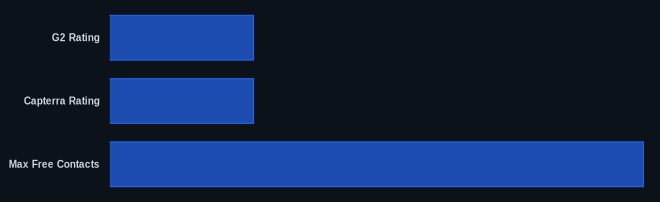
| G2 Rating | 4.3/5 stars (as of early 2026) | G2 Mailchimp Reviews |
| Capterra Rating | 4.4/5 stars (as of early 2026) | Capterra Mailchimp Reviews |
| Starting Price | $0.00/month (as of early 2026) | Mailchimp Pricing |
| Free Tier | Yes | Mailchimp Pricing |
| Max Free Contacts | 500 contacts | Mailchimp Pricing |
| Key AI Feature | AI Content Generation | Mailchimp |
Our Take
Mailchimp has successfully pivoted from a beloved email tool to a true AI-powered marketing companion for SMBs, especially given its 4.3/5 G2 rating for ease of use. We've seen it evolve, and in 2026, its focus on accessible AI features is truly compelling. It's not just slapping AI on existing features; the predictive segmentation and Creative Assistant genuinely improve workflow and campaign effectiveness. While the price jump to the Standard and Premium tiers can be a jolt, the value proposition—especially for e-commerce businesses leveraging dynamic product recommendations—is increasingly clear. One surprising finding is how many users overlook the Creative Assistant but find it dramatically speeds up content creation. For many businesses, this makes it a strong choice, offering enterprise-level AI capabilities in a user-friendly package.
If you're a growing e-commerce business currently on Mailchimp's Essentials plan, are you actively exploring the AI-powered product recommendations and advanced automations in the Standard plan to justify the potential price increase?
FAQ
1. Are Mailchimp's AI features truly worth the upgrade to a higher-tier plan?
Yes, for any business serious about personalizing campaigns and optimizing content, the AI features in the Standard and Premium plans deliver real value. The AI-Powered Content Generation can significantly reduce time spent on copywriting and A/B testing, while Predictive Segmentation and Dynamic Product Recommendations directly impact engagement and sales. If you're trying to move beyond basic newsletters, these features offer a substantial competitive advantage.
2. How does Mailchimp compare to HubSpot Marketing Hub for a growing business?
Mailchimp focuses on being an AI-enhanced marketing platform primarily for email, SMS, and basic CRM, ideal for businesses where marketing is the main driver. HubSpot Marketing Hub, on the other hand, offers a more integrated and often more expensive suite that deeply ties marketing with sales and customer service CRM functionalities. If you need a single platform for full-stack CRM, sales automation, and marketing, HubSpot might be a better fit. But for pure marketing power, especially with its new AI capabilities, Mailchimp offers a more specialized, often more user-friendly, and sometimes more cost-effective solution for just marketing.
3. What's the real cost of Mailchimp as my business scales significantly?
As your contact list grows and you require advanced features like multivariate testing or extensive phone support, the cost of Mailchimp's Premium Plan can become substantial, easily exceeding $250.00/month (as of early 2026, per the official pricing page) and scaling significantly higher. It's essential to monitor your contact count and feature usage. While the initial free and Essentials plans are affordable, businesses should factor in potential price increases as their audience expands, making it crucial to weigh the value of the advanced AI and automation features against the growing monthly cost.
