Mailchimp’s pricing, particularly its charge for unsubscribed contacts, makes it an increasingly costly option for growing businesses, despite its advanced AI and e-commerce tools. This review helps entrepreneurs, remote teams, and SMBs understand if the platform’s features justify its escalating price tag.
What Is Mailchimp?
This marketing and commerce platform, now part of Intuit, helps businesses manage email campaigns, build landing pages, automate customer journeys, and grow their audience. It's designed for users from solo entrepreneurs to established e-commerce brands needing sophisticated segmentation. The tool combines email marketing with CRM-like features, website building, and transactional messaging.
Many start with Mailchimp because of its recognizable brand and user-friendly interface. But as businesses scale, its billing structure quickly becomes a primary consideration. The platform aims to be an all-in-one solution for marketing and sales, integrating deeply with various e-commerce platforms.
Key Features
Mailchimp continues to expand its capabilities, with a significant push into artificial intelligence and e-commerce functionalities. These updates aim to keep it competitive in a crowded market.
AI Marketing & Automation
The platform's newest features focus heavily on AI. In May 2026, it expanded AI capabilities with Claude and ChatGPT connectors for crafting emails and SMS campaigns. Analytics AI helps users understand performance without needing a data science degree. Predictive analytics identifies high-value or at-risk customers, allowing for proactive marketing. The Creative Assistant offers AI-driven design recommendations, and send-time optimization ensures emails land when recipients are most likely to engage. Multi-step customer journeys are a cornerstone of its automation suite, though these remain gated to higher tiers.
Email Marketing & Design
Mailchimp built its reputation on an intuitive drag-and-drop email editor. It comes with an extensive library of professional, customizable templates suitable for various industries and campaigns. Users can quickly create visually appealing emails without needing coding skills. The recent addition of Saved Sections in May 2026 allows for reusing common email blocks, speeding up design workflows. A/B testing is available on paid plans, letting marketers optimize their content and subject lines.
E-commerce Tools
For businesses selling online, the platform offers solid integrations and dedicated features. It now includes a proprietary Site Tracking Pixel for Wix, WooCommerce, and Shopify, providing deeper insights into customer behavior. Expanded SMS marketing capabilities offer age-gating and instant opt-in options, making it more compliant and user-friendly. Enhanced transactional messaging via a unified API simplifies sending order confirmations and shipping updates. New migration tools also aim to ease the transition for businesses moving from other platforms.
Audience Management & Segmentation
Effective marketing relies on knowing your audience. The tool allows users to build and segment their contact lists based on engagement, purchase history, demographics, and more. While the Free plan is now limited to a single audience, paid plans offer multiple audiences. This segmentation powers personalized campaigns and automations, ensuring messages resonate with the right people. However, duplicate contacts across multiple audiences are billed separately, a key point of contention for many users.
Pricing
Mailchimp's pricing structure is a significant talking point, driven by contact count and plan features. As of October 2026, per the official pricing page, it offers four marketing plans.
-
Free Plan: Effective February 17, 2026, this plan is now severely limited to 250 contacts and 500 email sends/month, with a 250 daily send limit. It includes basic templates, signup forms, and 30 days of email support. Crucially, multi-step automations, A/B testing, and email scheduling have been removed. This represents a drastic reduction from previous limits, making it viable only for the very smallest lists.
-
Essentials Plan: Starting at $13/month (as of February 17, 2026, per the official pricing page) for 500 contacts, this tier removes Mailchimp branding and unlocks key features. You get email scheduling, A/B testing, all templates, and 24/7 email/chat support. Monthly sends are capped at 10x your contact count. It supports up to 3 audiences and 3 user seats, but multi-step automations are not included. For 5,000 contacts, the cost jumps to approximately $75/month (as of February 17, 2026, per the official pricing page).
-
Standard Plan: Beginning at $20/month (as of February 17, 2026, per the official pricing page) for 500 contacts, this is where Mailchimp's advanced automation truly shines. It includes multi-step customer journeys, send-time optimization, and dynamic content. Users can have 5 audiences and 5 user seats, with monthly send limits at 12x their contact count. Pricing escalates quickly: at 10,000 contacts, it's around $135/month (as of February 17, 2026, per the official pricing page); at 50,000 contacts, roughly $450/month (as of February 17, 2026, per the official pricing page). This plan also unlocks transactional email as an add-on.
-
Premium Plan: Starting at $350/month (as of February 17, 2026, per the official pricing page) for 10,000 contacts, this plan is for large organizations needing comprehensive features and priority support. It offers unlimited emails (up to 15x contact limit), unlimited users/audiences, multivariate testing, comparative reports, and priority phone support. It can accommodate up to 200,000 contacts, with custom pricing for larger lists.
Hidden Costs and Add-ons:
This is where many users get caught. The platform charges for unsubscribed and non-subscribed contacts unless they are manually archived or deleted. If you have duplicate contacts across multiple audiences, each instance is counted separately, directly inflating your monthly bill.
Transactional email (Mandrill) is a separate paid add-on, starting at $20 per block of 25,000 emails (as of June 2026, per the official pricing page), and only available for Standard and Premium plans. SMS marketing is also a paid add-on, with credits expiring monthly. Custom domains for Mailchimp landing pages cost an additional $9/month (as of June 2026, per the official pricing page).
In April 2026, legacy plan users (accounts created before May 2019) saw price increases of 11-13%. This follows an earlier January 2026 reduction in free plan limits.
Pros and Cons
Mailchimp has a strong reputation, but its evolution in 2026 comes with significant trade-offs for users.
Pros:
- Ease of Use: The drag-and-drop email builder is intuitive, making it simple for beginners and small teams to create professional campaigns. According to a G2 reviewer: "Mailchimp makes email marketing easy for beginners and small teams without needing big tech."
- Extensive Template Library & Design Flexibility: It offers a wide variety of polished, customizable templates and design options, including the new Saved Sections, to match diverse brand aesthetics. Per a Capterra user: "The email editor is excellent, the template library is extensive, and the brand carries weight."
- Powerful AI Marketing Features: New AI content generation (Claude/ChatGPT connectors), predictive analytics, send-time optimization, and Creative Assistant offer genuine advantages for optimizing campaign performance, especially on Standard and Premium plans.
- Strong E-commerce Integrations and Analytics: Deep integrations with platforms like Shopify and WooCommerce, along with detailed revenue attribution reports and the new Site Tracking Pixel, provide valuable insights for online businesses.
- Market Presence: The platform's widespread adoption means extensive resources, tutorials, and a broad community are available for support.
Cons:
- Exorbitant and Unpredictable Pricing: Pricing escalates rapidly with list growth. The most repeated complaint is the charging for unsubscribed and non-subscribed contacts, significantly inflating costs. According to one G2 reviewer: "Pricing escalates quickly as your list grows — and Mailchimp charges for unsubscribed contacts, inflating costs significantly." This gets expensive fast.
- Severely Limited Free Plan: The February 2026 reductions to 250 contacts and 500 sends, plus the removal of automations and A/B testing, make the free tier almost unusable for businesses aiming for any growth. It's now more of a basic trial than a starting point.
- Feature Gating: Essential marketing automation features, like multi-step customer journeys, are locked behind the more expensive Standard plan. Businesses looking for automation will quickly outgrow the Essentials tier.
- Customer Support Quality Concerns: While basic email/chat support is available on paid plans, users frequently report slow response times and difficulty resolving complex technical issues. A Capterra user shared: "The support team handles basic questions well, but complex technical issues… often require escalation and multiple exchanges." Phone support is exclusive to the Premium plan.
- GDPR Compliance Ambiguity: As a US-based company, Mailchimp faces ongoing scrutiny regarding GDPR compliance for EU users, especially concerning data transfers and US surveillance laws. This can be a concern for businesses needing airtight legal assurances.
- Billing for Multiple Audiences: If you use multiple audiences, duplicate contacts count towards your bill multiple times, leading to unexpected cost hikes.
Who Should Use Mailchimp?
Mailchimp is not for everyone, especially with its 2026 pricing and feature changes. It targets specific use cases effectively.
Very Small Startups or Hobbyists: The Free plan, despite its drastic cuts, still offers basic email sending and signup forms for lists under 250 contacts. It's barely functional for a growing business, but it's a starting point for someone just collecting their first few leads without needing automation.
Small Businesses Prioritizing Design and Ease of Use: If your primary need is beautifully designed emails and straightforward audience management, and you're comfortable with the Essentials plan's pricing for a list up to a few thousand contacts, it's a strong contender. This is ideal for solopreneurs or small teams that value simplicity over complex automation.
E-commerce Brands with Moderate to Large Budgets: The Standard and Premium plans, with their advanced automation, AI features, and deep e-commerce integrations, offer significant value for online stores. If you're running complex customer journeys, need predictive analytics, and prioritize detailed revenue reporting, the platform can deliver. Just be prepared for the cost of scaling, especially with the unsubscribed contact billing.
Businesses Needing Detailed Reporting and Integrations: Organizations that rely on detailed campaign performance reports, revenue attribution, and seamless integrations with CRM or e-commerce platforms will find its analytics suite beneficial.
If you're a growing SMB focused on maximizing automation on a tighter budget, or if you have a rapidly expanding list where cost predictability is paramount, alternatives like MailerLite or ActiveCampaign often present better value. Compared to Mailchimp, Moosend often wins on affordability and simplicity for similar feature sets.
Data at a Glance
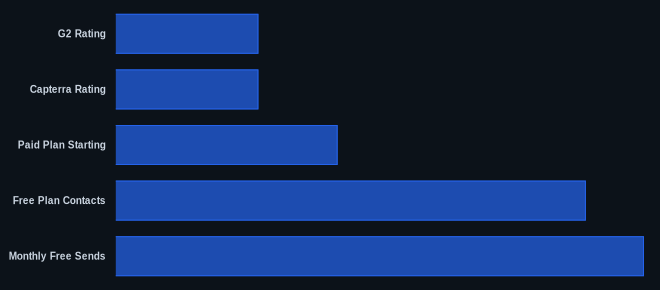
| Metric | Value | Source |
|---|---|---|
| G2 Rating | 4.3/5 stars | G2 Reviews |
| Capterra Rating | 4.5/5 stars | Capterra Reviews |
| Starting Price | $0/month (Free) | Mailchimp Pricing |
| Paid Plan Starting | $13/month | Mailchimp Pricing |
| Free Plan Contacts | 250 contacts | Mailchimp Pricing |
| Monthly Free Sends | 500 sends | Mailchimp Pricing |
| Phone Support | Premium only | Mailchimp Pricing |
Our Take
We've seen Mailchimp lean heavily into AI and e-commerce, which is smart. But it feels like they’re trying to justify increasingly aggressive pricing and free plan reductions. It’s hard to recommend the platform wholeheartedly when it nickel-and-dimes you for unsubscribed contacts — a practice that directly punishes list growth and inflates bills. While the AI is impressive and can deliver real results, for many businesses, the hidden costs will easily overshadow those gains, forcing a switch to more transparent alternatives. If you’re a small business currently using Mailchimp and seeing your bill jump for unsubscribed contacts, have you calculated how much you'd save by switching to an alternative like MailerLite or Moosend?
FAQ
Q: Does Mailchimp charge for unsubscribed contacts in 2026?
A: Yes, as of 2026, Mailchimp continues to charge for unsubscribed and non-subscribed contacts unless you manually archive or delete them. This is a significant pain point for users, directly contributing to higher monthly costs as your list grows, even if a portion of it is inactive.
Q: What are the main limitations of the Mailchimp Free plan in 2026?
A: The Free plan is now severely limited to 250 contacts and 500 email sends per month (with a 250 daily limit). Crucially, key features like multi-step automations, A/B testing, and email scheduling have been removed. This makes it suitable only for very basic needs or as a temporary trial.
Q: Are there better alternatives to Mailchimp for small businesses in 2026?
A: For small businesses seeking more predictable pricing, better automation on lower tiers, or more accessible customer support, alternatives like MailerLite (for affordability and simplicity) or ActiveCampaign (for advanced automation and CRM) often provide better value. Constant Contact is also praised for its accessible phone support. The choice depends on your specific needs and budget.